
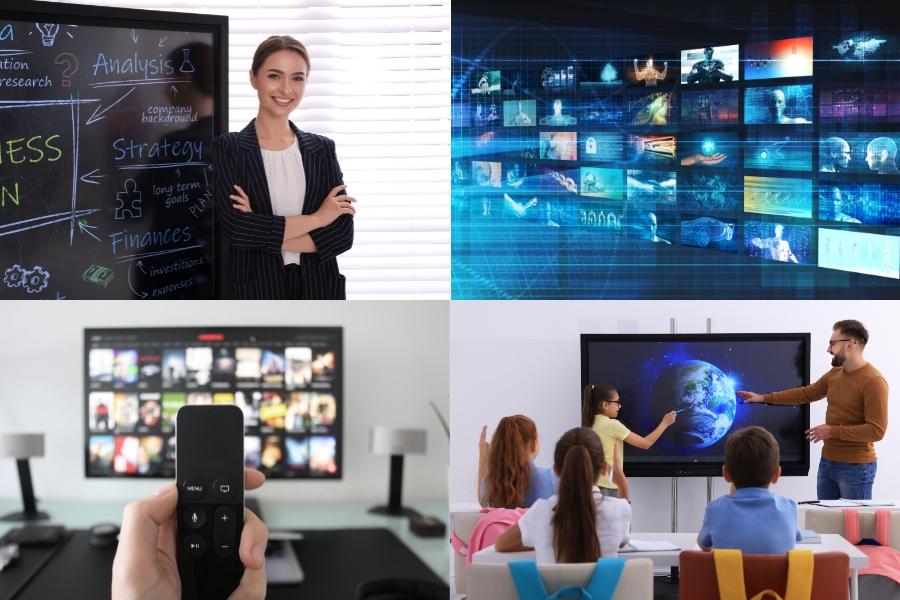

In today’s rapidly advancing technological era, the use of digital IT devices such as interactive display media and smart TVs has become increasingly popular. Both are widely used in education, business, and entertainment. However, despite their similar appearance, there are fundamental differences between them.
This article explores those differences and how each device plays a role in the digital IT world.
Functions and Usage in the Digital IT Context
A smart TV is a television connected to the internet, allowing users to access digital content such as streaming services, social media, and applications. It is mainly used for home entertainment and comes with features like voice assistants and smart home integration.
On the other hand, interactive display media is designed for more complex user interaction. Commonly used in business and education, it supports touch screens, stylus input, and collaborative features.
With digital IT technology, interactive displays are often used in meeting rooms, classrooms, and exhibitions for interactive presentations, training sessions, and teamwork.
Interactivity Capabilities in Digital IT
One of the key differences between interactive displays and smart TVs is the level of interactivity. Smart TVs allow interaction through remote controls or voice commands but offer limited user input.
In contrast, interactive displays are built for direct engagement, supporting touch input and enabling users to draw or write directly on the screen.
In business environments, this allows teams to collaborate in real time by creating diagrams, adding notes, and interacting with digital content. In education, it provides a more dynamic and immersive learning experience.
Connectivity and Integration in Digital IT Systems
Both devices offer internet connectivity and application support, but interactive displays usually provide more integration options with laptops, smartphones, and other devices for presentations and collaboration.
Smart TVs are primarily focused on entertainment and offer more limited integration with business or educational tools. Although screen sharing is available, the level of collaboration remains lower than that of interactive displays.
Therefore…
The main differences between interactive display media and smart TVs lie in their level of interactivity, functionality, and integration with other digital IT systems.
Smart TVs are ideal for home entertainment, while interactive displays are better suited for business and educational environments that require collaboration and engagement.
Enhance your business in the digital era with ARU Digital, the best solution for your business needs. For more information, visit: https://aruraharja.co.id/


Leave a Comment
Start discussion and ask your questions — I will be happy to answer.